


Trial Library, rebranded so five audiences hear one company
Trial Library puts cancer trials inside routine care. Its platform has to convince providers, sponsors, payers, employers and patients at once. They want opposite things from the same system. I rebuilt the brand as a system engineering could ship from, designed the marketing site, three campaigns, and shaped feature implementations on the conversational trial search.
- Product design
- Design systems
- Health tech
- Campaign design
- Industry
- Oncology clinical research
- Role
- Product & Brand Designer
- Team
- Samuel Yusuf
- Scope
- Strategy, Product Design, Research
Overview
Everyone in the room, and no single way to talk to them
Context
Trial Library is an AI-native platform. It puts clinical trials inside routine care: activating providers, finding eligible patients, navigating them through enrolment. The home page states the thesis plainly: “The Clinical Trial System Is Broken. We’re Fixing It.”
Problem: five audiences whose incentives pull apart.
A sponsor wants enrolment speed. A payer wants cost containment. A provider wants no new software. A patient wants to understand a word of it. The brand had to hold all five without flattening into hospital beige. The AI tool had to earn clinical trust in seconds.
What the work had to do
Three jobs, each with a different reader and a different tolerance for being sold to. The same system had to carry all three.
How might one company hold a single voice across five audiences, and an AI trial search earn enough trust to be acted on?
Impact
Where the work landed
Rethinking Trial Library’s brand system and marketing site laid the foundation beyond the front door, helping accelerate provider and sponsor onboarding while shaping the design direction for new product capabilities like conversational trial search.
- Raised to date. The $10M Series A closed with this brand in market
- $15M
- Providers in the network the Sponsors page sells
- 3,000+
- Active trial sites in that network
- 840+
- Patients referred across all brand touchpoints
- 1,000+
The problem
The same broken system, felt five different ways
Each audience meets the failure at a different point. The brand has to answer all of them from one position.
| Audience | Where the system fails them | What the brand has to prove |
|---|---|---|
| Patients | Fewer than 5% of eligible patients ever enrol. Most never hear a trial exists. | That a trial is a care option. In plain language, without pressure. |
| Providers | 85% of cancer patients are treated in community settings. Trials were never built to reach there. | No new system, login or work. |
| Sponsors | 80% of trials miss enrolment deadlines. 85% of sites enrol fewer than five patients. | Reach into a contracted network, and patients who actually qualify. |
| Payers & employers | Cancer claims compound. One member can breach a $150K stop-loss threshold. | That research is a cost mechanism. |
| The AI itself | A chat box asking for a patient profile is a clinical and privacy risk before it is a feature. | What it used, why it matched, and where its data stops. |
“Fewer than 5% of eligible patients ever enroll in a clinical trial. Most never hear about one.”
My role
Product and brand, designed as one system
Product and Brand Designer. Design system, brand, marketing site, campaigns, and features on the conversational trial search.
- Design system on shadcn/ui
- Off Material UI, onto shadcn primitives. Twenty-nine component sets as variants and states.
- Brand definition
- How one company talks to a sponsor and a patient without splitting in two.
- Marketing website
- Improving the communication direction of the brand.
- Campaign design
- Three campaigns end to end.
Phase 1Design system
Swapping the foundation under a shipping product
Trial Library was building on Material UI. I came in and laid the foundations of a new system, with shadcn as the informing library.
The rules underneath it
The move was about drift. A brand defined outside the component library gets reinterpreted at build time, and drifts inside a quarter. Writing it in shadcn’s terms meant variants and states, named the way the code names them.
Phase 2Website
Addressing concerns of all audience classes involved
Phase 3Conversational Trial Search
Describe a patient in a sentence, get trials you can act on
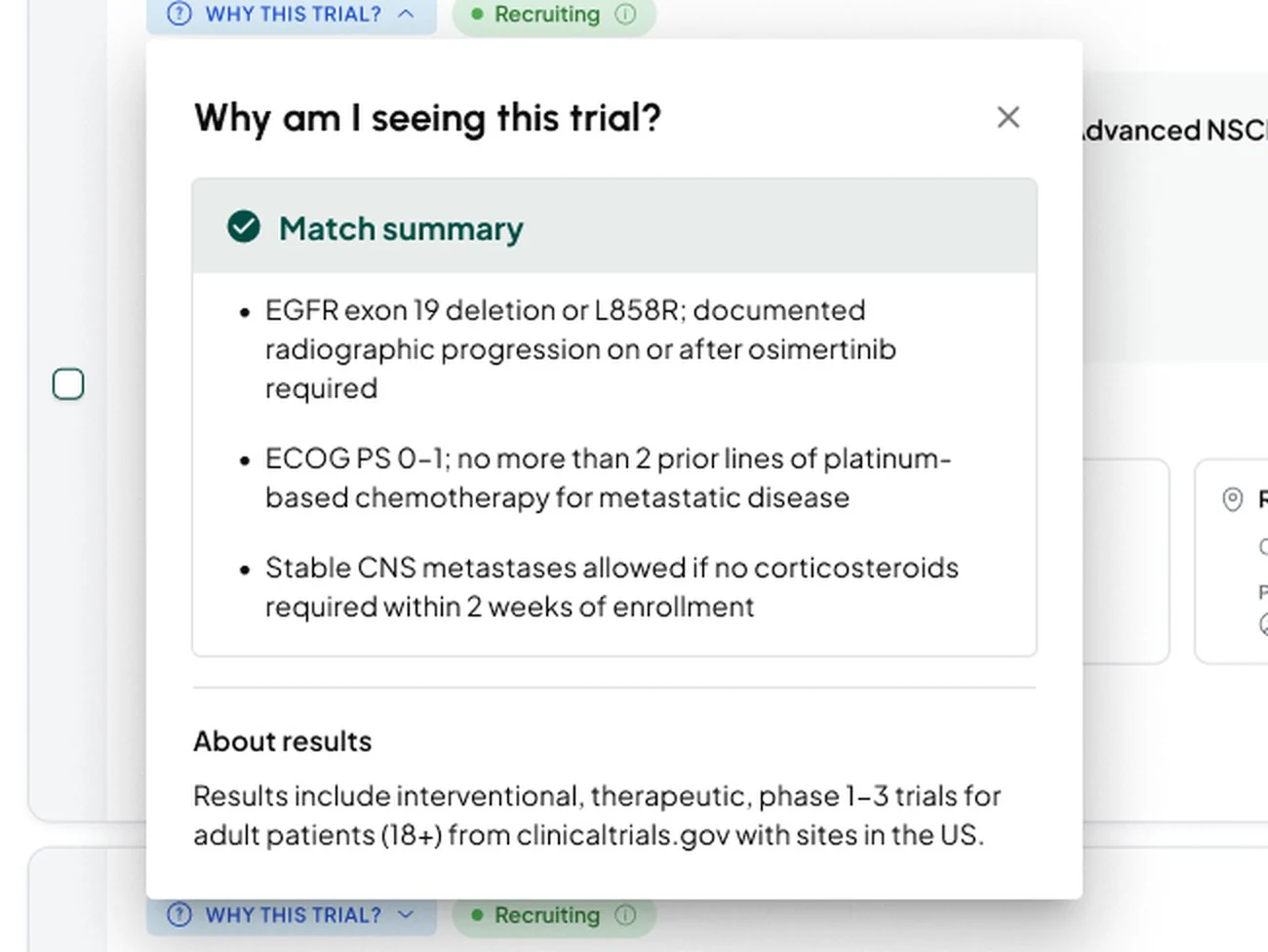
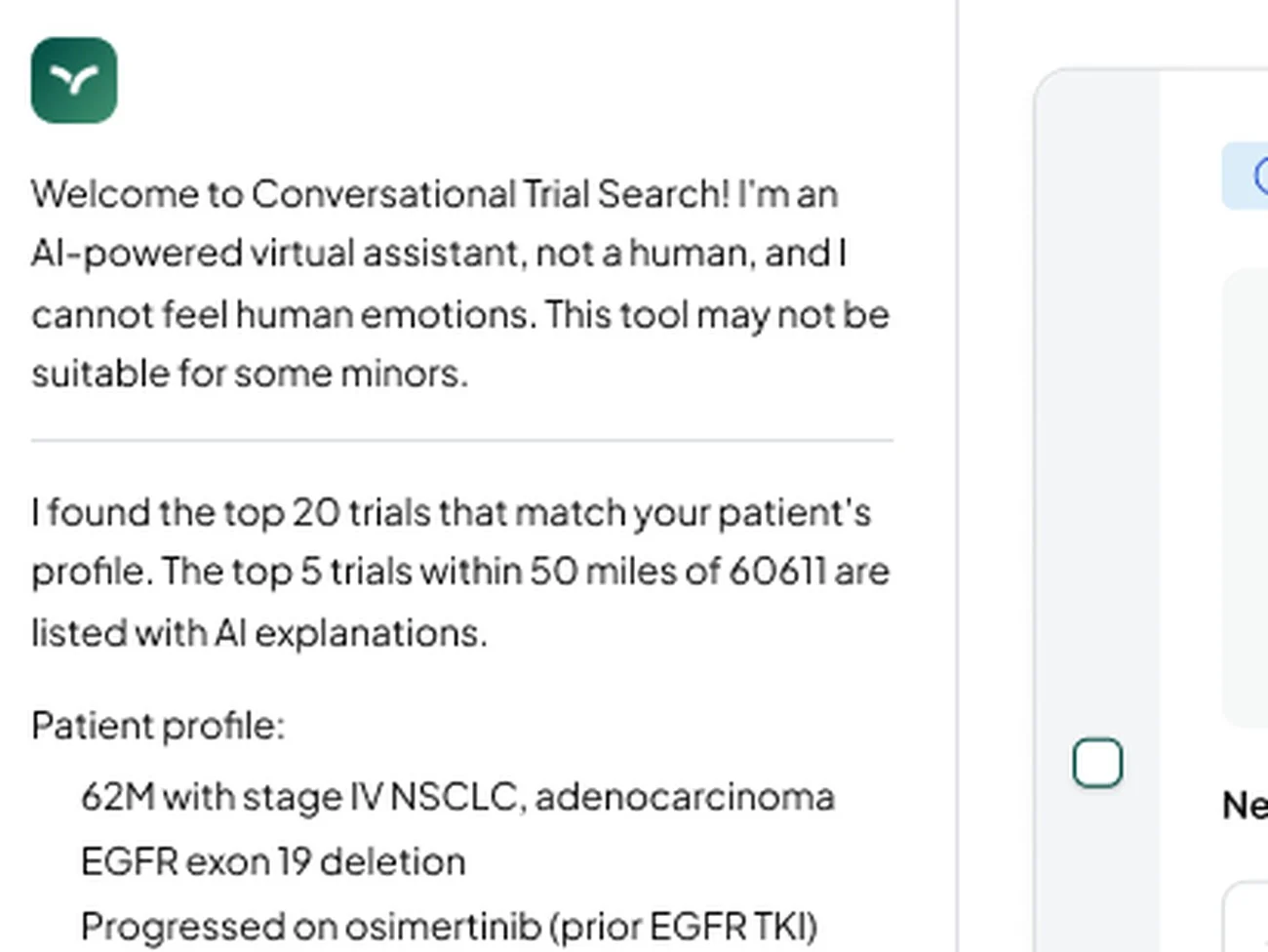
A provider picks a cancer type, sets a radius, and types the patient in clinical shorthand. The system ranks the matches and explains each one. Built for the two minutes between appointments.
What makes it usable at the bedside
Each result carries the NCT number, phase, recruiting status, interventions, the nearest sites with named investigators, and whether navigation support exists. The actions are the ones a clinician needs: Copy for EMR, Share trial, Contact study team, Email myself these results.
Phase 4Campaigns
Three campaigns in three registers, built from the same parts
Collaboration
One system, built with the people who ship and sell it
Engineering built from the shadcn components I defined, so the brand held through build without a separate spec to police it. I worked with leadership, PMs and engineers from the first brand direction to what shipped, designing the brand system, marketing site, campaigns and trial search features side by side so the provider tools and the patient screens read as one company.
